
Research about the challenges posed by redistricting, such as gerrymandering and malapportionment, often focuses on American politics. In the United States, public awareness on these challenges is high, gerrymandering being at the center of political debates. France lacks such debates, which are considered a non-issue, a problem only America faces. Although it is true that partisan gerrymandering is far more developed in the United States than in France, malapportionment is an issue that has in great part been fixed by federal courts in America, while it remains a significant challenge in the Hexagon that has yet to arise in national political debates.
Map 1

Malapportionment is a situation in which electoral constituencies are unequal in population to an extent that violates the principle of “One man, one vote.” In Reynold v. Sims (1964), one of the three major redistricting cases decided by the Warren Court in the 1960s, the Supreme Court found that malapportionment, sometimes enshrined in state constitutions by clauses guaranteeing at least one state senator per county, was a violation of the 14th amendment’s equal protection clause. In Wesberry v. Sanders (1964), Associate Justice Hugo Black wrote that “As nearly as is practical, one man’s vote in a congressional election is to be worth as much as another’s.” Map makers should therefore draw congressional and legislative plans that minimize the demographic gap between districts, making sure they stay as close as possible to the ideal population of a district (ideal population = state population / number of districts). We can calculate the extent to which a congressional or legislative map is malapportioned by calculating its maximum population deviation, which is to say how bigger the most populous district is than the ideal district and how smaller the least populous is than the ideal district. Although no clear legal requirement states what exactly the largest maximum population deviation can be, the Supreme Court has rejected congressional maps with a maximum population deviation of 5.97% (Kirkpatrick v. Preisler, 1969), 0.79% (Tennant v. Jefferson County Commission, 2012), or even 0.6984% (Karcher v. Daggett, 1983). When it comes to state legislative districts, the Supreme Court argued in Harris v. Arizona Independent Redistricting Commission (2016) that state legislative plans’ maximum population deviation could reach up to 10% before being considered a violation of the “One man, one vote” principle.
–
How to calculate the “Maximum population deviation”
((Most populous district’s population – Least populous district’s population) / Average district’s population) *100
–
In electing the members of the lower chamber of its Parliament, France uses a two-round majority voting system. Its Députés are elected in single-member voting districts called circonscriptions. Candidates obtaining at least 12.5% of registered voters (registered votes = votes for a candidate + blank votes + abstaining voters + spoilt votes) qualify to a second round where the candidate obtaining the most votes wins. Most of the time, only two candidates qualify for the second round.
Like in any country using voting districts, redistricting matters in the balance of power in the National Assembly. This process, however, is not regular, constituencies’ lines having been redrawn only three times since the creation of the 5th Republic, in 1958, 1986, and 2010 (Sauger and Grofman, 2016).
Redistricting the circonscriptions in France
The number of Députés in the National Assembly is fixed by the electoral code, whose article LO119 fixed its membership to 577 in 2009. In theory, it means that reapportionment in France is a zero-sum game where, in order for some departments to gain seats, others have to lose constituencies. In practice, the number of députés has been modified in 1985 and 2009 before each reapportionment, and once in 1964. Reapportionment, however, is still a sort of zero-sum game, because although the number of constituencies has consistently increased, the increase was never large enough to prevent every department from losing seats. In 2009, for example, the number of députés was only raised from 570 to 577.
Legal requirements surrounding redistricting of the National Assembly’s circonscriptions in France generally follow three principles: Roughly equal population, adaptation to coherent geographic units and contiguity. In a 2009 report to the National Assembly, Député Charles de La Verpillière enumerated the various redistricting principles that would apply in the 2010 redistricting process:
- The circonscriptions shall be contiguous except if an insurmountable geographic obstacle prevents it (enclaves);
- Communes of fewer than 5,000 inhabitants shall not be divided into multiples circonscriptions;
- Except in Paris, Lyon, and Marseille, contiguous cantons of fewer than 40,000 inhabitants shall not be cracked;
- No circonscription’s population shall by more than 20% exceed or subceed that of the average circonscription in a given department or overseas collectivity.
Apart from the communal contiguity requirement, these rules lack coherence. If a circonscriptions can exceed or subceed the average population of a constituency by 20%, towns much larger than 5,000 inhabitants could be protected from being splitted, as this population gap allows for much flexibility. The principle stipulating that cantons should also be protected from being divided into more than one constituency stands on shaky grounds, as cantons are not a meaningful geographic unit. In his recent attempt to introduce a dose of proportional representation in the legislative voting system, President Emmanuel Macron’s plan implied redrawing a reduced number of circonscriptions. Although the reform was eventually abandoned, the government intended to keep this principle of keeping cantons from being split into multiple constituencies, a principle that makes even less sense now since the cantons are, since 2014, mere voting districts for departmental elections that in no way relate to significant geographic or cultural regions. The government’s plan also intended to keep the same population discrepancy standard, allowing for a maximum of 20% deviation from the average population. That standard means that it is considered acceptable for a department of 200,000 inhabitants that has been granted two constituencies to have one of 80,000 inhabitants and another of 120,000 inhabitants. The maximum deviation population of such a map would be 40%, far from the American standard of 0.7 to 0.8% for congressional districts and 10% for legislative districts. Furthermore, the fact that France only redraws its circonscriptions when the executive deems it necessary would make it even more important to implement strict standards in population deviation, because constituencies’ lines might last for a long time (twenty-four years between the 1986 and the 2010 redistricting laws, for example).
In 2009, the Constitutional Council put an end to the long-standing practice of granting a minimum of two circonscriptions by department, a deliberate malapportionment that largely increased the voting power of the citizens of rural and sparsely populated departments. The Council deemed the practice contrary to the principle of “One man, one vote.” If the department of Lozère had kept its second circonscription following the 2010 census, it would have had two constituencies of roughly 38,000 inhabitants in 2019, while the national average is close to 120,000.
The French malapportionment
Using the 2019 population by circonscription provided by the INSEE, the National Institute of Statistics and Economic Studies, we find that four constituencies out of 577 have a population that is by more than 20% superior or inferior to the population of their department’s average constituency population. Following the standard set by French legislators, this is still a good deviation although the first signs of malapportionment are showing up. But with this legal standard, a 20% gap between a constituency’s population and the ideal population (meaning a maximum population deviation of up to 40%) is seen as acceptable although it is enshrining unfair representation in the electoral process. Indeed, with such a large deviation, the chances for an electoral minority dominant in sparsely populated constituencies to win a majority in the National Assembly increase.
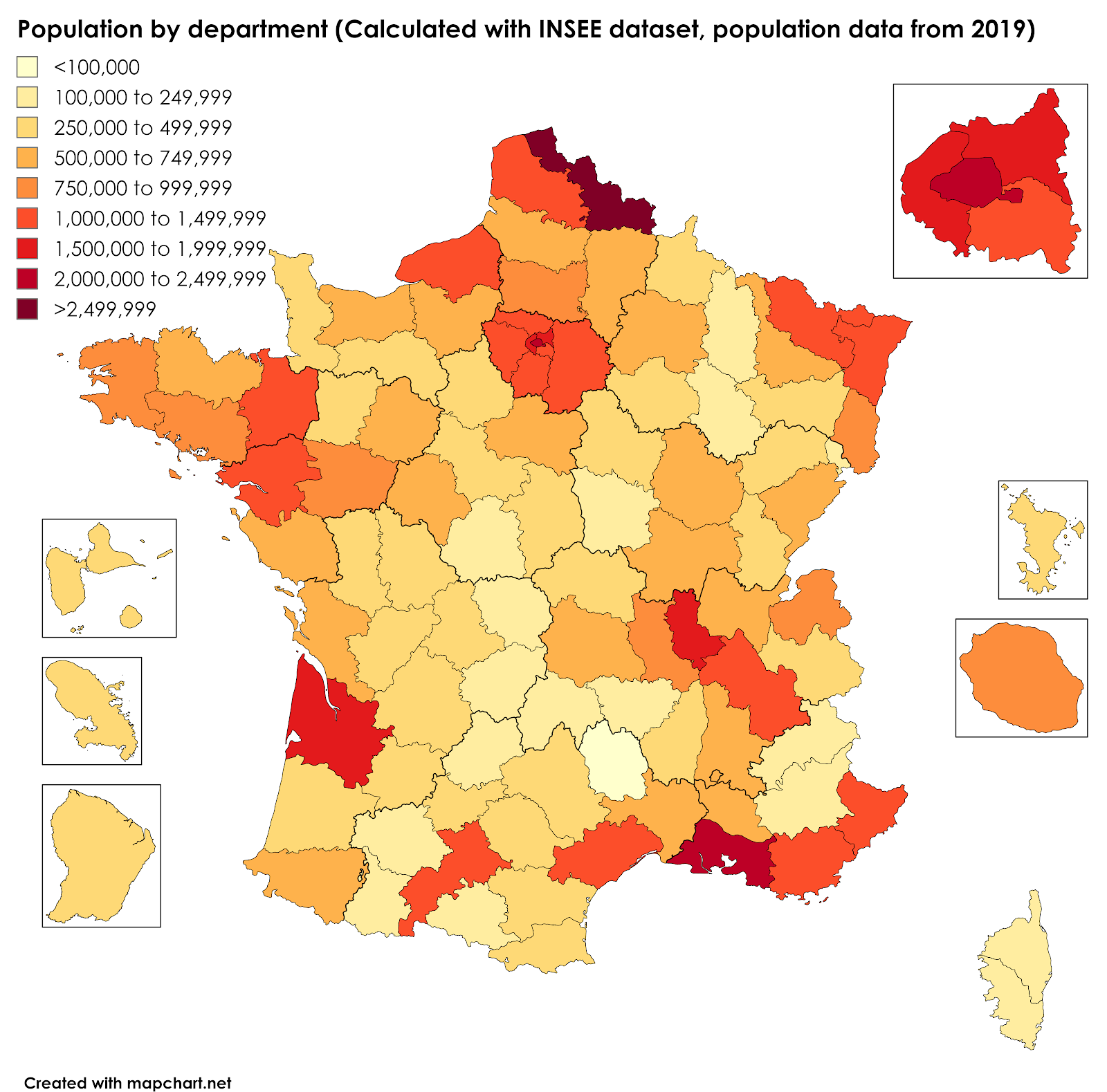
As of 2019, small departments with two or three circonscriptions generally had a lower maximum population deviation (see maps 1 and 2), while in other departments the correlation between deviation and number of constituencies was not as obvious. Loire’s department, for instance, has 6 constituencies against Paris’ 18. Yet, its population deviation is much higher, around 40%, while Paris’ deviation is between 10 and 15%. It is not evident either that population deviation is correlated to population change at the departmental level (map 3). I would argue that internal population changes, regardless of departmentwide demographic evolution, are the biggest driver of malapportionment. In Moselle, for example, the maximum population deviation jumped from 30.4% to 36.2% from 2013 to 2019. Yet, over this period of time, Moselle’s population stagnated, the department losing 0.03% of its population. Internal population changes drove this sharp increase in population deviation. The lowest populated constituency, the 5th circonscription, lost 2.49% of its population while the 9th circonscription, the most populated constituency of the department, gained 3.10%.
| 2013 | 2019 | Evolution | |
| 1st circonscription | 124,229 | 127,400 | +2.55% |
| 2nd circonscription | 109,288 | 109,618 | +0.30% |
| 3rd circonscription | 108,770 | 110,914 | +1.97% |
| 4th circonscription | 107,986 | 105,468 | -2.33% |
| 5th circonscription | 99,982 | 97,488 | -2.49% |
| 6th circonscription | 105,489 | 102,022 | -3.29% |
| 7th circonscription | 126,989 | 123,659 | -2.62% |
| 8th circonscription | 128,798 | 130,440 | +1.27% |
| 9th circonscription | 135,342 | 139,534 | +3.10% |
| Total population | 1,046,873 | 1,046,543 | -0.03% |
| Maximum population deviation | 30.40% | 36.16% | +5.76 points |
France’s malapportionment problem has two main sources: the redistricting process does not happen on a regular basis and its equal population standards are too lax. Redistricting only happens in France when the executive understands how large population gaps between constituencies have become. The adoption of a regular redistricting cycle would ensure the enforcement of equal population principles are not left up to the executive’s understanding of malapportionment. A 40% maximum population deviation makes redistricting less effective as constituencies’ populations are very unequal from the moment the legislative lines are redrawn. Limiting every department’s maximum population deviation to 5% at the time of redistricting would better ensure the respect of the “One man, one vote” principle. The closer in population constituencies are, the better, thus the only rational argument against that standard is its practicality. Is it possible to draw constituencies that are close in population without splitting cantons? It probably is not. But respecting cantons’ lines is less important than guaranteeing the equal worth of citizens’ voting power. Is it possible to draw electoral maps with a maximum population deviation under 5%? Yes. Most French communes have a small population, which allows for a very close deviation without unnecessarily splitting the communes.
Conclusion
Malapportionment is a pregnant problem in France. While the United States progressively solved this issue through a series of court cases, France’s civil law system does not allow for a solution to emerge from the judicial system. A long-term solution would need to emerge either from the executive or from the Parliament. The current lax rules surrounding population deviation, the canton contiguity rule, and the absence of a regular redistricting cycle make it difficult for France to solve its malapportionment problem. As we will see in part 2 of this series on malapportionment in France, the problem is even greater in the cantons, the voting districts used to elect the members of departmental councils.
Map 2

Map 3: Population growth or decline by department, 2013 to 2018

Map 4
Map 5

Resources:
-Citizens registered on electoral lists as of January 1st, 2024 in French abroad constituencies: Décret n° 2023-18 du 19 janvier 2023 authentifiant la population des Français établis hors de France au 1er janvier 2023 – Légifrance (legifrance.gouv.fr)
-Commune, arrondissement, canton and department lines, geojson: france-geojson/departements/89-yonne/cantons-89-yonne.geojson at master · gregoiredavid/france-geojson · GitHub
-Congressional Research Service, “Congressional Redistricting 2021: Legal Framework”
-French Electoral Code: Code électoral – Légifrance (legifrance.gouv.fr)
-Karcher v. Daggett, 462 U.S. 725 (1983): Karcher v. Daggett :: 462 U.S. 725 (1983) :: Justia US Supreme Court Center
-Kirkpatrick v. Preisler, 394 U.S. 526 (1969): Kirkpatrick v. Preisler :: 394 U.S. 526 (1969) :: Justia US Supreme Court Center
-Population by commune, canton, arrondissement, departments and regions as of January 1st, 2020: Téléchargement des fichiers par départements des populations légales en 2020 − Populations légales 2020 | Insee
-Population by National Assembly constituency as of January 1st, 2019: Populations légales des circonscriptions législatives pour les élections de 2022 | Insee
-Report Number 1949 (2009) to the National Assembly: Microsoft Word – R1949.doc (assemblee-nationale.fr)
-Reynolds v. Sims, 377 U.S. 533 (1964): Reynolds v. Sims :: 377 U.S. 533 (1964) :: Justia US Supreme Court Center
-Sauger, N. and Grofman, B. (2016). Partisan biais and redistricting in France. Electoral Studies, 44:388–396.
-Tennant v. Jefferson County, 567 U.S. 758 (2012): Tennant v. Jefferson County :: 567 U.S. 758 (2012) :: Justia US Supreme Court Center
-Wesberry v. Sanders, 376 U.S. 1 (1964): Wesberry v. Sanders :: 376 U.S. 1 (1964) :: Justia US Supreme Court Center
French political vocabulary
| Canton | Voting districts for departmental elections |
|---|---|
| Circonscription | Single-member constituency that elects a member of the National Assembly |
| Assemblée Nationale | Lower chamber of the Parliament |
| Députés | Members of the National Assembly |
| Communes | Townships |
| Départements | Geographic unit larger than the commune and smaller than the region |

 Political Analysis Center
Leave a comment